



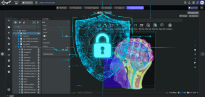
 Offline anonymization: Removing of recognizable features from magnetic resonance images.
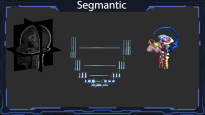 Personalization: Automatic segmentation from magnetic resonance images.
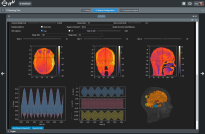 Identification of optimal configuration: Visualization and report generation.
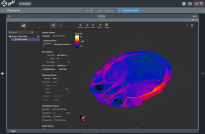 Exposure analysis: Interactive exploration and visualization in Sim4Life.web.
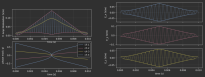 Visualization of advanced phase modulation schemes and pulse shapes of the complete electric field and its x-, y- and z-components in TIP.
TI Planning Tool TIP
At IT'IS, we are committed to supporting innovative, safe, and effective therapies through cutting-edge computational life and health sciences.
The Temporal Interference Planning Tool (TIP) is an online research platform for planning, optimizing, and visualizing temporal interference (TI) stimulation protocols. TIP guides researchers from target definition and model selection to optimized electrode configurations, exposure analysis, and reporting – with advanced electromagnetic simulations running in a cloud-based workflow powered by o²S²PARC technology.
Background
Temporal interference (TI) stimulation has attracted intense interest because of its potential to modulate deep brain regions non-invasively while reducing activation of overlying structures. As research groups increasingly prepare animal and human TI studies, TIP provides an accessible route to computational planning for neuroscientists and brain-stimulation experts who may not have specialized modeling expertise.
What TIP Supports
- Target definition and setup: define target regions and constraints for potential electrode placement
- Anatomical models: work with precomputed high-resolution models or use personalized models generated from magnetic resonance imaging (MRI) data
- Simulation modes: plan classic TI, multi-channel TI, and phase-modulation TI protocols
- Optimization: identify stimulation protocols through automated multi-goal optimization, quantitative quality metrics, and interactive refinement
- Exposure analysis: review field distributions and derived exposure quantities through integration with Sim4Life.web
- Reporting: export detailed reports with protocol parameters, performance metrics, field visualizations, and information compatible with the Temporal Interference Brain Stimulator for Research (TIBS-R)
Current TIP Options
| Version | URL | Users |
| TIP V5.2 | tip.science | Early Adopter Program, TI Solutions AG |
| TIP.lite | tip-lite.science | Students and Researchers |
A brief history of TIP
The continual development of TIP has been informed by feedback from the TI research community. The guided online planning workflow, precomputed anatomical models, optimization and reporting capabilities, and interactive exposure visualization were established already in previous versions of the tool.
Personalization – which has been supported since the release of TIP V4.0 – allows users to generate subject-specific head models from MRI data, benefit from automated anatomical fiducial detection for consistent 10–10 electrode placement, and use the surrogate-model-based optimizer (SuMo) to efficiently explore electrode configurations. TIP V5.0 built on this foundation with privacy-first local personalization, a more comprehensive Sim4Life workflow for exposure analysis, and an optimizer that runs approximately 5× faster.
In TIP V5.2, the optimization workflow is even further advanced and the multi-objective optimizer is smarter and more capable: native constraint handling eliminates impractical solutions from the search, parallel multi-seed execution yields richer Pareto fronts with more diverse and superior configurations, and automatic convergence detection stops optimization as soon as improvement falls below a user-defined threshold for low, medium, or high precision. Delivery of higher-quality electrode recommendations is guaranteed.
Request & Inquiries
TIP V5.2 is available to groups enrolled in the TI Solutions Early Adopter Program, including eligible TIBS-R users and participating IT'IS research partners. Access to the tool is provided at no cost for eligible users. Personalized cloud simulations are charged according to the applicable Amazon Web Services (AWS) simulation cost, currently approximately US$60 per personalized subject; precomputed models remain free-of-charge to explore.
For access requests, technical information, or support, please contact tip@itis.swiss or call +41 44 245 9898.
Make sure to also check out the latest version of the TI Brain Stimulator for Research (TIBS-R) from our Z43 partner TI Solutions AG.
Acknowledgment
We gratefully acknowledge the clinical insights, and critical feedback of the teams of Prof. Grossman (Imperial College London, UK) and Prof. Hummel (EPFL, Switzerland).


