



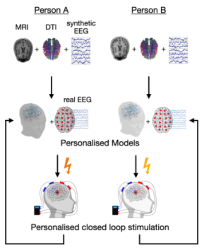
Subject-specific anatomical data and model-based synthetic EEG are used to generate individualized neural network models. These models can help guide personalized closed-loop stimulation using live EEG recordings.
Neural Signals and Closed-Loop Neuromodulation
Model-Based Analysis of Neural Signals
We build models of brain recordings to support interpretation and maximize the information content of signals and interfaces (e.g., EEG, MEG, LFP, eCAP, EIT). Subject-specific anatomical modeling and synthetic signals support individualized inference and guide protocol design.
Closed-Loop Concepts
As brain activity is inherently dynamic, optimal stimulation must adapt to the network's continually fluctuating state. We employ personalized brain models to predict the real-time impact of stimulation, enabling adaptive, outcome-driven control. By integrating these predictions with live feedback (e.g., EEG), our systems aim to actively "steer" brain dynamics toward healthy patterns (e.g., restoring network fluidity or enhancing deep sleep) rather than delivering a fixed dose, thereby maximizing efficacy and safety (Karimi et al., 2025b).
Next Challenges
- Real-time pipelines: Specify and demonstrate robust closed-loop architectures (addressing latency budgets, blackout/readout windows, and controller design) to make adaptive stimulation clinically deployable.
References
Karimi, F. et al., 2025b. Precision non-invasive brain stimulation: An in silico pipeline for personalized control of brain dynamics. J. Neural Eng. 22, 026061. https://doi.org/10.1088/1741-2552/adb88f


