


Neuroengineering and Brain Interfaces

Brain Networks & Whole-Brain Dynamics
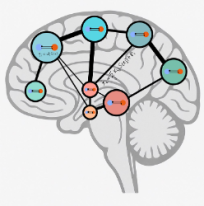
Schematic of a whole-brain neural mass network model capturing how local population dynamics interact to generate brain-wide activity patterns.
Brain Networks and Whole-Brain Dynamics
Neural-Mass and Network Modeling
To model brain-wide dynamics, we represent each brain region as a neural mass (population mean-field dynamics) and connect regions into coupled, subject-specific networks using MRI-derived anatomy and connectivity (T1/T2 parcellations; DTI/tractography). Compared with single-neuron simulations, neural-mass networks enable efficient parameter sweeps, uncertainty quantification, and optimization—and may be constrained by individual EEG/fMRI and other biomarkers for enhanced personalization.
Selected Achievements
- BraiNN: A JAX-accelerated neural-mass framework supporting gradient-based and surrogate-guided optimization, large parameter sweeps, and subject-specific predictions at surface-mesh scale—bringing network-level inference into practical time frames.
Next Challenges
- From dose to effect: Strengthen links from physical exposure to neural modulation using biomarkers (e.g., EEG/sleep metrics, cognitive endpoints) and uncertainty quantification.
- Bridging scales and modalities: Harmonize axon-level and population-level models and integrate EM with complementary modalities (e.g., acoustic, optical, pharmacological).
- Generalizable AI for neuroengineering: Develop hybrid physics-ML surrogates to accelerate optimization while preserving interpretability.


