



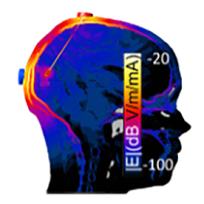
Anatomical head model with a tDCS montage and an abandoned 0.2 mm diameter lead, with a zoomed version showing the lead tip (g, h). Current density magnitude on a slace containing the lead with zoom (i, j). E-field magnitude on a slice containing the lead with zoom (k, l) (Karimi et al., 2025a).
Medical Devices and Safety Assessment
Clinical Translation, Device Design and Safety Assessment
We combine computational neural models and EM simulations in realistic anatomical models to improve the safety and efficacy of clinical neuromodulation—including bioelectronic medicine and MRI safety—and to accelerate the development of novel stimulation approaches such as temporal interference stimulation (TIS) and low-intensity focused ultrasound (LIFUS). By integrating computational tools into device design pipelines, we support rapid prototyping, in silico trials, and the generation of evidence relevant for regulatory decision-making.
Focus Areas
- Innovative neurostimulation approaches, bioelectronic medicine, and MRI safety: Pioneering work on TIS (Grossman et al., 2017) and LIFUS for noninvasive, deep, and focal brain stimulation, alongside studies that elucidate the underlying interaction mechanisms (Lemaire et al., 2019; Missey et al., 2025).
Selected Achievements
- Extensive industry support: Provision of regulatory-grade safety assessments and design optimization for medical devices (e.g., vagus nerve stimulation, spinal cord stimulation, deep brain stimulation implants, and recording electrodes).
- Standardization leadership: Contributions to committees refining evidence-based dose constraints and safety standards (Cassarà et al., 2025a, 2025b; Karimi et al., 2025a; Neufeld et al., 2016a, 2016b).
- Restoration of locomotion: Collaboration with the NEURORESTORE team utilizing in silico tools for implant design, mechanism elucidation, and treatment personalization to restore locomotion in people with paraplegia. This approach reduced parameter identification time from months to days (Gupta et al., 2020; Phillips et al., 2025; Rowald et al., 2022; Wagner et al., 2018).
Selected Collaborations
- ETH Zurich (Prof. Janos Vörös): TIS in patterned neural networks on CMOS multielectrode arrays.
- King's College London (Dr. Ines Violante): TIS for sleep and memory (Violante et al., 2023).
- Ghent University (4Brain): Patient-specific closed-loop TIS for epilepsy using rodent brain slices and in vivo setups.
- St. Anne's University Hospital Brno (Prof. Adam Williamson): Hippocampal TIS, epileptic biomarkers, and multichannel TIS (Acerbo et al., 2022; Botzanowski et al., 2025; Missey et al., 2026).
- EPFL (Prof. Friedrich Hummel): TIS applications in stroke recovery, associative memory, and motor learning (Beanato et al., 2024; Popa et al., 2023; Wessel et al., 2023).
- Harvard Medical School (Prof. Alvaro Pascual-Leone): TIS safety and human hippocampal stimulation (Cassarà et al., 2025a, 2025b; Violante et al., 2023).
- Wisconsin Institute for Sleep and Consciousness (Prof. Giulio Tononi): TIS and sleep-dependent brain dynamics (Schaeffer et al., 2025).
- Imperial College London (Prof. Nir Grossman): TIS for modulating hippocampal dynamics and behavioral outcomes (Violante et al., 2023).
For a comprehensive list of our contributions to safety standards and bioelectronic medicine, view our full publication archive.
References
Acerbo, E. et al., 2022. Focal non-invasive deep-brain stimulation with temporal interference for the suppression of epileptic biomarkers. Front. Neurosci. 16, 945221. https://doi.org/10.3389/fnins.2022.945221
Beanato, E. et al., 2024. Noninvasive modulation of the hippocampal-entorhinal complex during spatial navigation in humans. Sci. Adv. 10, eado4103. https://doi.org/10.1126/sciadv.ado4103
Botzanowski, B. et al., 2025. Focal control of non-invasive deep brain stimulation using multipolar temporal interference. Bioelectron Med 11, 7. https://doi.org/10.1186/s42234-025-00169-6
Cassarà, A.M. et al., 2025a. Recommendations for the Safe Application of Temporal Interference Stimulation in the Human Brain Part I: Principles of Electrical Neuromodulation and Adverse Effects. Bioelectromagnetics 46, e22542. https://doi.org/10.1002/bem.22542
Cassarà, A.M. et al., 2025b. Recommendations for the safe application of temporal interference stimulation in the human brain part II: Biophysics, dosimetry, and safety recommendations. Bioelectromagnetics 46, e22536. https://doi.org/10.1002/bem.22536
Grossman, N. et al., 2017. Noninvasive deep brain stimulation via temporally interfering electric fields. Cell 169, 1029–1041. https://doi.org/10.1016/j.cell.2017.05.024
Karimi, F. et al., 2025a. Safety of non-invasive brain stimulation in patients with implants: a computational risk assessment. J. Neural Eng. 22, 016039. https://doi.org/10.1088/1741-2552/ad8efa
Lemaire, T. et al., 2019. Understanding ultrasound neuromodulation using a computationally efficient and interpretable model of intramembrane cavitation. J. Neural Eng. 16, 046007. https://doi.org/10.1088/1741-2552/ab1685
Missey, F. et al., 2026. Non-invasive temporal interference stimulation of the hippocampus suppresses epileptic biomarkers in patients with Epilepsy: biophysical differences between kilohertz and amplitude modulated stimulation. Brain Stimulation 19, 102981. https://doi.org/10.1016/j.brs.2025.11.008
Missey, F. et al., 2025. Temporal Interference Stimulation Can Enhance or Disrupt Human Memory Encoding as a Function of Brain Location and Frequency. https://doi.org/10.1101/2025.09.22.677714
Neufeld, E. et al., 2016a. Functionalized anatomical models for EM-neuron interaction modeling. Phys. Med. Biol. 61, 4390–4401. https://doi.org/10.1088/0031-9155/61/12/4390
Neufeld, E. et al., 2016b. Investigation of assumptions underlying current safety guidelines on EM-induced nerve stimulation. Phys. Med. Biol. 61, 4466–4478. https://doi.org/10.1088/0031-9155/61/12/4466
Gupta, I. et al., 2020. Quantification of clinically applicable stimulation parameters for precision near-organ neuromodulation of human splenic nerves. Commun. Biol. 3, 577. https://doi.org/10.1038/s42003-020-01299-0
Phillips, A.A. et al., 2025. An implantable system to restore hemodynamic stability after spinal cord injury. Nat Med 31, 2946–2957. https://doi.org/10.1038/s41591-025-03614-w
Popa, T. et al., 2023. Effects of hippocampal noninvasive theta-burst stimulation on consolidation of associative memory in healthy older adults. https://doi.org/10.1101/2023.10.11.554933
Rowald, A. et al., 2022. Activity-dependent spinal cord neuromodulation rapidly restores trunk and leg motor functions after complete paralysis. Nat Med 28, 260–271. https://doi.org/10.1038/s41591-021-01663-5
Schaeffer, E. et al., 2025. Enhancement of sleep slow waves using transcranial electrical stimulation with temporal interference (TES-TI), in: Abstract Collection of SLEEP 2025. Presented at the SLEEP 2025, SLEEP 2025, Seattle, USA.
Violante, I. et al., 2023. Non-invasive temporal interference electrical stimulation of the human hippocampus. Nat Neurosci 26, 1994–2004. https://doi.org/10.1038/s41593-023-01517-y
Wagner, F.B. et al., 2018. Targeted neurotechnology restores walking in humans with spinal cord injury. Nature 563, 65–71. https://doi.org/10.1038/s41586-018-0649-2
Wessel, M.J. et al., 2023. Noninvasive theta-burst stimulation of the human striatum enhances striatal activity and motor skill learning. Nat Neurosci 26, 2005–2016. https://doi.org/10.1038/s41593-023-01457-7


