



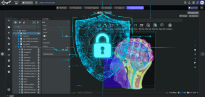
 Offline anonymization: Removing of recognizable features from magnetic resonance images.
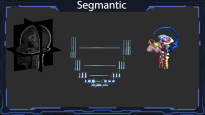 Personalization: Automatic segmentation from magnetic resonance images.
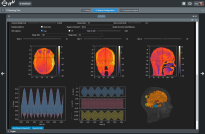 Identification of optimal configuration: Visualization and report generation.
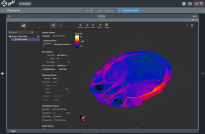 Exposure analysis: Interactive exploration and visualization in Sim4Life.web.
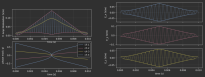 Visualization of advanced phase modulation schemes and pulse shapes of the complete electric field and its x-, y- and z-components in TIP.
TIP V5.2: Smarter Optimization, Better Results, Your Choice of Speed
TIP V5.2, the latest release of our online platform for planning temporal interference stimulation studies, delivers a focused overhaul of the surrogate-model-based optimizer (SuMo). All of the advanced features of TIP V5.0 are preserved (see this video), while three synergistic improvements produce higher-quality and richer Pareto fronts and give users direct control over the trade-off between speed and thoroughness.
Core capabilities carried forward
-
Guided TI planning workflow: Move from subject and target definition to optimized stimulation protocols and report generation in a few steps
-
Personalized and precomputed models: Plan with established head and animal models or with subject-specific models generated from magnetic resonance imaging (MRI) data
-
Advanced TI modes: Support for classic TI, multi-channel TI, and phase-modulation TI workflows
-
Privacy-first local personalization: Run MRI processing locally – only the anonymized model is uploaded
-
Full Sim4Life environment in Exposure Analysis: Model, simulate, and analyze in one place
-
Exposure visualization and reporting: Inspect field distributions, calculate derived exposure quantities, and export detailed protocol reports
Basic Functionality of TIP
What is new in TIP V5.2?
-
Native constraint handling for physically applicable configurations: Impractical electrode configurations – such as two channels that share the same physical electrode or electrodes that are placed too close together – are now handled through native Dakota constraints rather than through imposed penalties. As a result, the optimizer operates on a smooth and accurate SuMo surface, resulting in better exploration and a Pareto front composed exclusively of deployable configurations.
-
Parallel multi-seed optimization with Pareto front merging: The optimizer now runs multiple independent searches in parallel (6 seeds by default), each exploring a different region of the electrode search space. The resulting Pareto fronts are merged via non-dominated sorting to produce a single, denser front with richer and superior configurations with optimal objective trade-offs — without increasing wall-clock time.
-
Adaptive convergence with user-selectable precision: Instead of always executing a fixed number of iterations, the optimizer now monitors the hypervolume indicator and each of the parallel optimization threads and stops as soon as convergence is detected. The user selects from three available levels of precision, each of which is backed by evolutionary algorithm parameters that have been systematically optimized via hyperparameter search:
-
Low: Fast exploratory results for quick iteration results
-
Medium: Balanced coverage, recommended for standard clinical planning
-
High: Maximum Pareto front completeness and quality for the most thorough analysis
-
What these improvements mean in practice
- Richer Pareto fronts: More and superior electrode configuration options that cover a wider range of trade-offs between stimulation strength, selectivity, and collateral exposure are presented to the clinician
- No impractical configurations: Every configuration on the Pareto front is physically deployable – no manual filtering of outcomes is required
- User-controlled precision selects the speed: Choose low for a rapid first look, medium for everyday planning, or high for the most exhaustive search, and the optimizer adapts accordingly
Request & Inquiries
TIP V5.2 is available to groups enrolled in the TI Solutions Early Adopter Program, including eligible TIBS-R users and participating IT'IS research partners. Access to the tool is provided at no cost for eligible users. Personalized cloud simulations are charged according to the applicable Amazon Web Services (AWS) simulation cost, currently approximately US$60 per personalized subject. Precomputed models remain free-of-charge to explore.
For access requests, technical questions, or support, please contact tip@itis.swiss.
Make sure to also check out the latest version of the TI Brain Stimulator for Research (TIBS-R) from our Z43 partner TI Solutions AG.
Reference for Citation
Please, cite the use of TIP in your publications, as follows: "IT'IS Foundation, (2026, June 11), Temporal Interference Planning Tool TIP V5.2. https://tip.science"
Disclaimer
By using the TI Planning Tool (TIP) (the "Software"), the End User agrees and acknowledges that the Software is a novel and experimental online tool developed for neuroscientists and brain stimulation experts to determine optimized electrode placement and stimulation conditions for targeting deep brain regions. The Software does not provide binding results and is not a substitute for the expert End User's own calculations of electrode placement and stimulation conditions for targeting deep brain regions. The Software is only intended to assist the expert End User in his/her own calculations. Therefore, the expert End User shall always ascertain the Software's results by doing his/her own calculations. DO NOT ACT SOLELY ON THE RESULTS OF THE SOFTWARE. The expert End User uses the Software and its results at his/her own risk. As a consequence, IT'IS Foundation does not give any representations and warranties for the Software and the liability of IT'IS Foundation in connection with the Software and its use and application is excluded to the full extent possible under the applicable law. IT'IS is not liable for any damages (including without limitation consequential, incidental, direct, indirect, special or punitive damages, damages for loss of profits, loss of use, business interruption, loss of information or data, or pecuniary loss) resulting from the use of or reliance on the Software. In particular, IT'IS Foundation is not responsible for (a) the correctness, completeness, integrity and accuracy of any data calculated by the Software, (b) any conclusions drawn by the End User or any third party from any simulation, calculation, modelling or other process or operation executed by the Software or by End User using the Software, (c) the technical, scientific, legal and commercial feasibility of any project, product and undertaking of the End User or any third party, and (d) the economic and financial viability of any project, product and undertaking of the End User or any third party.
By using the Software, the End User agrees to Swiss material law (excluding conflict of law rules) being applicable and the ordinary Swiss courts of Zurich, Canton of Zurich, having exclusive jurisdiction for all disputes arising out of or in connection with the Software and its use.


