



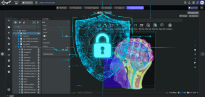
 Offline anonymization: Removing of recognizable features from magnetic resonance images.
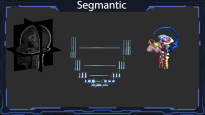 Personalization: Automatic segmentation from magnetic resonance images.
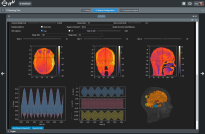 Identification of optimal configuration: Visualization and report generation.
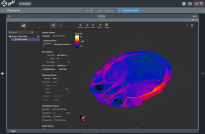 Exposure analysis: Interactive exploration and visualization in Sim4Life.web.
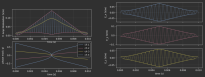 Visualization of advanced phase modulation schemes and pulse shapes of the complete electric field and its x-, y- and z-components in TIP.
TIP V5.0 - Privacy-first personalization, faster optimization, deeper analysis
TIP V5.0, the latest release of our online platform for planning temporal interference stimulation studies, combines the established TIP workflow – target definition, model selection, electromagnetic simulation, optimization, exposure analysis, and reporting – with new tools that give users greater control over privacy-sensitive imaging data, detailed simulation review, and optimization time. All features of TIP V4.0 are otherwise preserved.

Core capabilities carried forward
- Guided TI planning workflow: move from target and constraint definition to optimized stimulation protocols and report generation in a few step
- Personalized and precomputed models: plan with established head and animal models or with subject-specific models generated from magnetic resonance imaging (MRI) data
- Advanced TI modes: support for classic TI, multi-channel TI, and phase-modulation TI workflows
- Interactive multi-goal optimization: use quantitative metrics and visual feedback to balance target exposure strength, stimulation selectivity, and collateral exposure
- Exposure visualization and reporting: inspect field distributions, calculate derived exposure quantities, and export detailed protocol reports for study documentation
TIP V4.0: Basic Functionality of the Easy-to-Use TIP
What is new in TIP V5.0?
- Privacy-first personalization: With TIP V5.0, we introduce an offline personalizer for Windows that runs the MRI segmentation and head-model generation pipeline locally in Sim4Life V9.4 or later. Facial features are deformed locally, while the internal tissue geometry needed for accurate TI simulation is preserved. Raw MRI data remain on the user's computer; only the segmented, anonymized model is uploaded to TIP for cloud-based electromagnetic simulation and optimization.
- More complete Sim4Life workflow for exposure analysis: The Exposure Analysis step now opens a complete Sim4Life project environment rather than only a results viewer. Users can inspect the anatomical model, electrodes, targets, and simulation setup; review or adapt preconfigured multiport simulations; and investigate optimized electrode configurations in greater electromagnetic detail.
- Approximately 5× faster optimization: The surrogate-model-based (SuMo) optimizer has been accelerated through lead-field caching and Numba-accelerated field superposition. In benchmark runs, comprehensive optimizations that previously took around 1 hour can now typically be completed in approximately 5–10 minutes, making iterative planning more practical during an interactive session.
Advanced Features of TIP V5.0: Privacy by Design. 5x Faster. Full Sim4Life Power.
Personalization, from TIP V4.0 to TIP V5.0
Personalized planning is not new to TIP V5.0: since the release of TIP V4.0, users have been able to perform subject-specific planning based on MRI-derived head models, including automatic detection of anatomical fiducial markers for consistent 10-10 electrode placement. TIP V5.0 maintains this personalization capability but changes how privacy-sensitive imaging data are handled. With the new local personalizer, the MRI processing step can be performed on the user's own machine before a fully anonymized and segmented model is transferred to the cloud for simulation and optimization.
Sim4Life template projects
To help users move from optimized TIP results to detailed scientific exploration, TIP V5.0 provides ready-to-use Sim4Life template projects for all precomputed models – MIDA isotropic, MIDA anisotropic, IXI Female, IXI Male, and Mouse – as well as personalized models. Templates include the anatomical model, relevant tissue entities, targets, electrodes, and a preconfigured multiport simulation that can be used to recreate the lead-field library or to examine a specific optimized montage in detail.
Request & Inquiries
TIP V5.0 is available to groups enrolled in the TI Solutions Early Adopter Program, including eligible TIBS-R users and participating IT'IS research partners. Access to the tool is provided at no cost for eligible users. Personalized cloud simulations are charged according to the applicable Amazon Web Services (AWS) simulation cost, currently approximately US$60 per personalized subject. Precomputed models remain free-of-charge to explore.
For access requests, technical questions, or support, please contact tip@itis.swiss.
Make sure to also check out the latest version of the TI Brain Stimulator for Research (TIBS-R) from our Z43 partner TI Solutions AG.
Reference for Citation
Please, cite the use of TIP in your publications, as follows: "IT'IS Foundation, (2026, April 30), Temporal Interference Planning Tool TIP V5.0. https://tip.science"
Disclaimer
By using the TI Planning Tool (TIP) (the "Software"), the End User agrees and acknowledges that the Software is a novel and experimental online tool developed for neuroscientists and brain stimulation experts to determine optimized electrode placement and stimulation conditions for targeting deep brain regions. The Software does not provide binding results and is not a substitute for the expert End User's own calculations of electrode placement and stimulation conditions for targeting deep brain regions. The Software is only intended to assist the expert End User in his/her own calculations. Therefore, the expert End User shall always ascertain the Software's results by doing his/her own calculations. DO NOT ACT SOLELY ON THE RESULTS OF THE SOFTWARE. The expert End User uses the Software and its results at his/her own risk. As a consequence, IT'IS Foundation does not give any representations and warranties for the Software and the liability of IT'IS Foundation in connection with the Software and its use and application is excluded to the full extent possible under the applicable law. IT'IS is not liable for any damages (including without limitation consequential, incidental, direct, indirect, special or punitive damages, damages for loss of profits, loss of use, business interruption, loss of information or data, or pecuniary loss) resulting from the use of or reliance on the Software. In particular, IT'IS Foundation is not responsible for (a) the correctness, completeness, integrity and accuracy of any data calculated by the Software, (b) any conclusions drawn by the End User or any third party from any simulation, calculation, modelling or other process or operation executed by the Software or by End User using the Software, (c) the technical, scientific, legal and commercial feasibility of any project, product and undertaking of the End User or any third party, and (d) the economic and financial viability of any project, product and undertaking of the End User or any third party.
By using the Software, the End User agrees to Swiss material law (excluding conflict of law rules) being applicable and the ordinary Swiss courts of Zurich, Canton of Zurich, having exclusive jurisdiction for all disputes arising out of or in connection with the Software and its use.


